
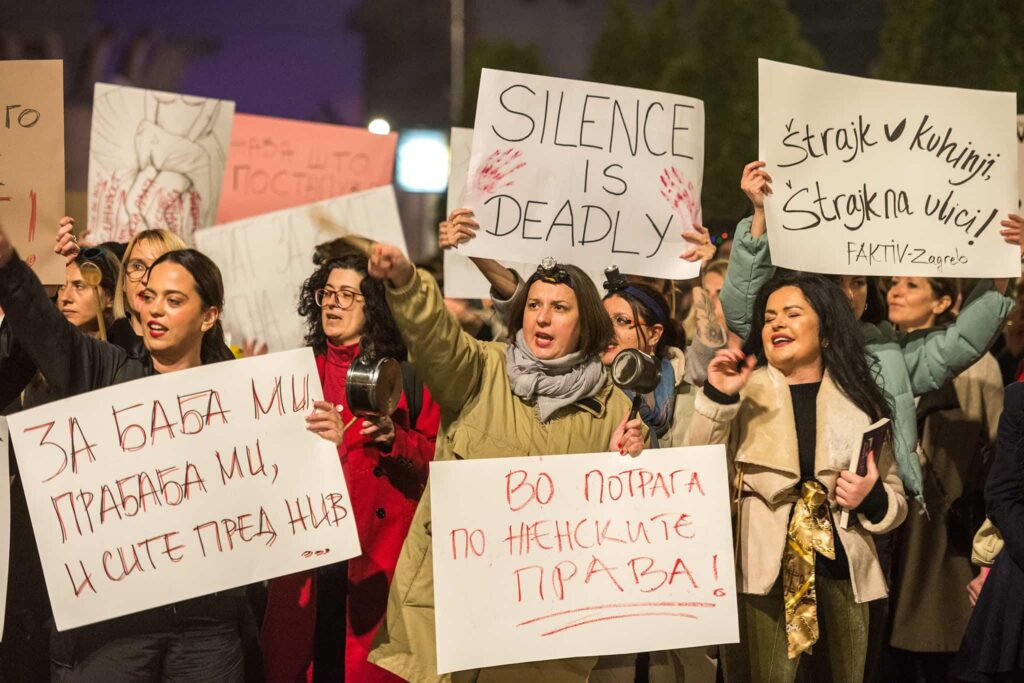
On March 8, on the occasion of the International Day for Economic, Political and Social Struggle for Women’s Equality, at 6:00 p.m. on Philip II Square, this year’s March for Women’s Rights began, under the slogan: “Will women survive here?”.
The march, organized by the Platform for Gender Equality and women’s rights activists, mobilized hundreds of attendees who protested against the happenings in our country and the collective neglect of women and girls in every way.

Reading the proclamation that conveys the message of this day, the activists emphasized that being a woman in Macedonia means waking up every morning in fear and wondering how and if you will survive that day, and the questions are numerous and are related to each a woman.
“Being a woman in Macedonia means wondering if there will be a place in the kindergarten for you to leave your child, if you will get to your workplace with the irregular public transport, and if your intimate space will be violated by male characters who touch you on the butt, justifying that it’s too busy, will you get fired because you’re pregnant, will you have to answer questions about your marital status at the job interview, will you get the job because you have a small child, will you end up with income that barely buy food and pay bills, will you get fired if you join a union to demand better conditions or if you report sexual harassment in the workplace. To be a woman means to accept a short-term job (work on the black, *under the table*), without resources for a stable career, without social protection and regulation.” – reads the proclamation read by the activists.

“Being a girl in Macedonia means wondering if you will survive this taxi ride without the taxi driver harassing you, if you will receive all kinds of comments, messages and threats on social networks, if your photos will be used as pornography, if you will have access to a gynecologist and free Pap test, will you survive the next routine medical intervention, will you survive childbirth… Being a woman in Macedonia means wondering if you will survive the daily violence from your partner that you have already tried to report, but the institutions that are supposed to protect you just made a record and did not act and protect you.” – the activists continued.

After the short address, the attendees marched along the route that stopped at several key points, and the march ended in the Zhena Borec Park, where the activists read their demands:
Systemic prevention and protection against sexual harassment, violence against women and family violence
Enforcement of justice and accountability for perpetrators
A legal framework that will protect and enable women to work without having to choose between family and the workplace
A health care system that will not be a lottery with a 50/50 chance of survival
A media that condemns rather than propagates violence
Women in politics who are not just symbolic in their involvement
Women need lighted and safe streets, regular public transport, clean hospitals, access to services and shelters from violence
A community that will accept and protect them when they are victims of violence, and will not reject and stigmatize them
Access to educational and professional opportunities, which intersect with gender stereotypes and traditional rigid roles
Finally, women need freedom, equality, solidarity, empathy, understanding and a value system that they can rely on and be an active stakeholder in.

The message is clear, an end to collective negligence is necessary, and the activists hope that the next March for Women’s Rights will not be under a slogan with a black script, but it remains to be seen whether essential changes will be introduced that will allow to improve the position of women in our country.
Photo: Vancho Djambaski, gallery available on Flickr.